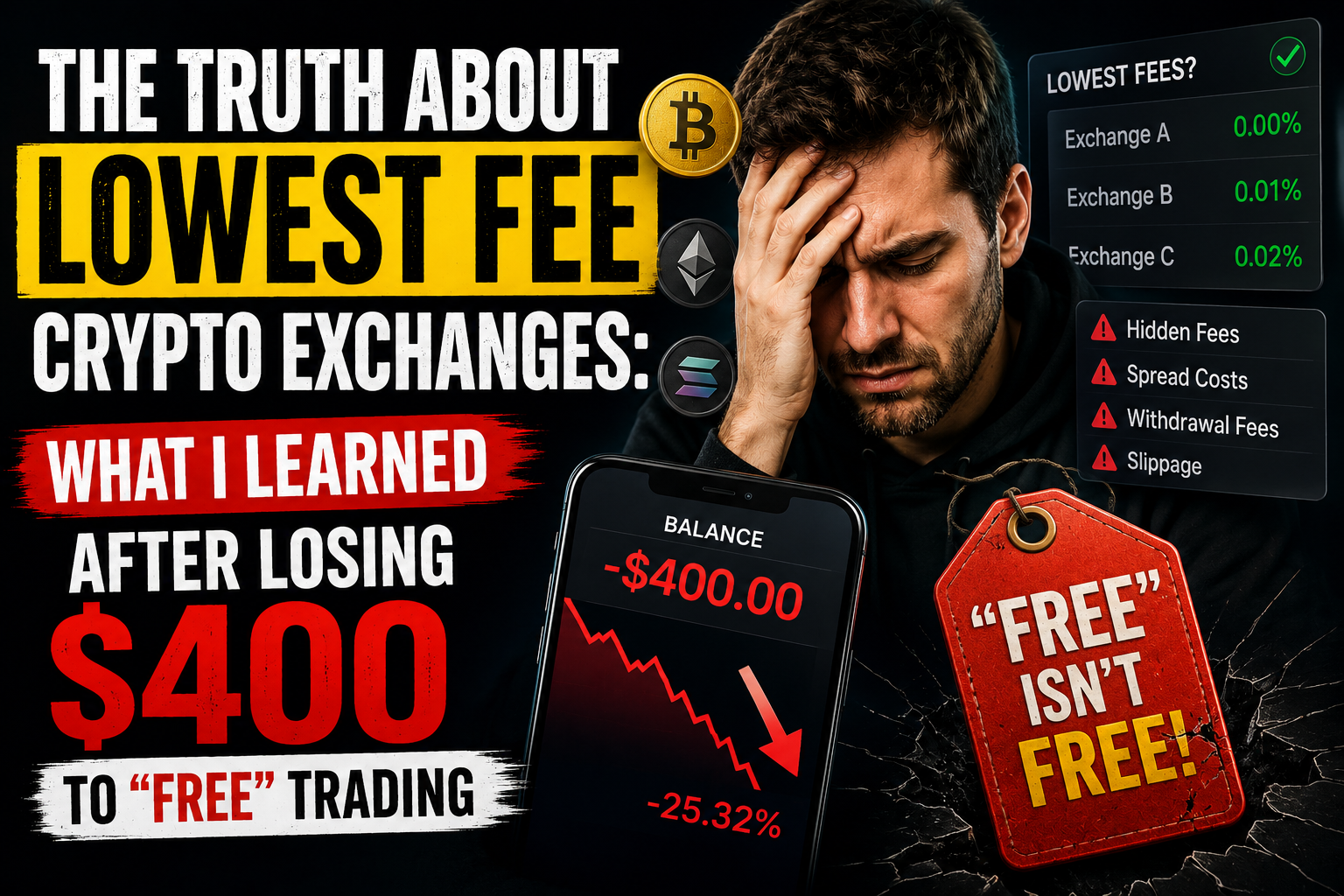
The Truth About Lowest Fee Crypto Exchanges: What I Learned After Losing $400 to “Free” Trading Let me start with something embarrassing. Back in 2021, I thought I was smart. Really smart. I signed up for this exchange that promised zero percent trading fees. Zero. The word felt like magic. I moved two thousand dollars worth of Bitcoin there and started trading like some Wall Street hotshot. Three months later, I checked my portfolio and almost threw my laptop across the room. I had lost money on almost every trade, but here’s the kicker – the exchange hadn’t charged me a single cent in fees. Or so I thought.
Turns out, the “lowest fee crypto exchange” doesn’t work the way most beginners think it does. And after burning through way too much money figuring this out, I want to share what actually matters when you’re trying to keep your coins instead of handing them over to exchanges.
Why I Stopped Believing the “Zero Fee” Hype
That exchange I mentioned? It was one of those “free” apps that everyone was recommending on TikTok. Zero trading fees. No commission. Sounds amazing until you realize they make money by giving you terrible prices. Every time I hit buy, the price was already three percent higher than what Bitcoin was actually trading for on real exchanges. When I sold? The price was three percent lower. So yeah, no explicit fee, but I was getting slaughtered on the spread without even knowing what a spread was.
That’s the dirty secret nobody tells you when you search for “lowest fee crypto exchange.” The advertised trading fee is only one piece of a much bigger puzzle. Sometimes it’s not even the most expensive piece.
Breaking Down What You Actually Pay
Before we get into which exchanges charge what, let me walk you through every single place your money disappears. Because I learned this the hard way, and I’d rather you didn’t.
The Trading Fee – This is the number exchanges shout from the rooftops. 0.1 percent. 0.2 percent. Sometimes zero. This is what you pay every time you buy or sell. But here’s what they don’t tell you – almost every exchange has two versions of this fee. Makers and takers. A maker is when you place an order that doesn’t execute immediately, like saying “I’ll buy Bitcoin when it hits forty thousand.” You’re adding liquidity to the exchange, so they charge you less. A taker is when you grab an existing order, saying “I’ll buy right now at whatever price someone’s selling.” You’re taking liquidity away, so they charge you more.
The Spread – This is where I got killed on that “free” exchange. Every cryptocurrency has two prices at any given moment. The bid price (what someone will pay you for your coin) and the ask price (what someone will sell you a coin for). The difference between them is the spread. On honest exchanges with lots of trading volume, this spread might be just a few cents. On shady “zero fee” platforms, the spread can be enormous because that’s how they pay their bills.
The Deposit Fee – Some exchanges charge you just to get your money in the door. This is more common with credit card deposits, where you might pay two or three percent just to fund your account. Bank transfers are usually cheaper or free, but they take days. Cash deposits? Some exchanges don’t even offer them.
The Withdrawal Fee – This one drives me crazy because it’s so sneaky. You trade all year paying tiny fees, feeling like a genius, and then when you finally want to move your Bitcoin to your own wallet or sell it for real cash, bam. Twenty dollars. Thirty dollars. Sometimes more. And unlike trading fees which are usually a percentage, withdrawal fees are often flat amounts. That means moving a hundred dollars in Bitcoin might cost you twenty percent in withdrawal fees, but moving ten thousand dollars only costs zero point two percent. Same fee, completely different impact.
Network Fees – This isn’t really the exchange’s fault, but you pay it anyway. Every time you send cryptocurrency to a different address, you pay the blockchain network a small fee. Exchanges sometimes bundle this into their withdrawal fee, sometimes list it separately. Either way, it comes out of your pocket.
The Real Contenders for Lowest Fees
After testing way too many exchanges over four years, here’s what I’ve found actually works if you care about keeping your money instead of feeding it to middlemen.
Binance gets mentioned in every “lowest fee crypto exchange” conversation for good reason. Their base trading fee is zero point one percent for both makers and takers. That’s already low. But if you hold their Binance Coin token and use it to pay fees, that drops by twenty five percent to zero point zero seven five percent. If you trade enough volume, it goes even lower. The problem? Binance has had regulatory headaches in a lot of places. Depending on where you live, you might not even be able to use them. And their withdrawal fees, while not the worst, aren’t the best either. Taking Bitcoin out costs around twenty dollars when the network is busy.
Kraken is my personal choice after getting burned by cheaper options. Their trading fees start at zero point one six percent for makers and zero point two six percent for takers if you’re just starting out. That’s higher than Binance. But here’s why I use them anyway – their execution is honest. The spread is tight. What you see is basically what you get. And their withdrawal fees are actually reasonable. Bitcoin withdrawals cost around ten dollars, sometimes less. More importantly, they’ve been around forever and never had a major hack. Sometimes paying a tiny bit more for honesty is worth it.
KuCoin is where I send people who really care about every fraction of a percent. Their base fees are zero point one percent for makers and zero point one percent for takers. Same as Binance. But if you hold their KuCoin Shares token, you get a discount that can push your fees down to zero point zero eight percent. They also have something called “level up” discounts based on how much you’ve traded in the last thirty days. The problem with KuCoin is it’s overwhelming. The interface looks like a spaceship cockpit. And their customer service is basically non-existent if something goes wrong. Fine for experienced traders. Terrifying for beginners.
MEXC came out of nowhere for me. I ignored them for years because their name sounds like some shady offshore operation. But their trading fees are zero point zero percent for makers and zero point zero five percent for takers. That’s genuinely lower than almost everyone else. They don’t even have a token discount system because the fees are already that cheap. The catch? Their liquidity isn’t as deep as the big exchanges. For popular coins like Bitcoin and Ethereum, you’re fine. But if you’re trading weird altcoins, you might get worse prices because there aren’t enough buyers and sellers. The spread widens, and suddenly that low fee doesn’t matter.
Bybit started as a derivatives exchange but now does regular trading too. Their spot trading fees are zero point one percent for makers and zero point one percent for takers. Nothing special. But their withdrawal fees are genuinely impressive. Bitcoin withdrawals cost just five dollars most of the time. That’s half of what Binance charges. If you’re planning to actually move your crypto off the exchange instead of just trading forever, those withdrawal savings add up fast.
The Hidden Fee That Nobody Talks About
Here’s something that took me two years to figure out. Exchanges make money on something called “payment for order flow.” It’s legal. Almost everyone does it. And it’s eating your lunch without you ever seeing a line item called “fee.”
Here’s how it works. You place an order to buy Bitcoin. The exchange doesn’t just send your order straight to the market. They send it to a trading firm that pays them for the privilege of executing your trade. That firm might give you a slightly worse price than you could have gotten elsewhere, but the price difference is so small you never notice. A fraction of a cent. But that fraction adds up across millions of trades, and the exchange gets rich while you get slightly poorer on every single trade.
Coinbase got in huge trouble for this a few years ago. The SEC fined them millions. But by then, they had already made billions from the practice. Every exchange does some version of this. The question is how much.
This is why I stopped obsessing over the advertised fee and started looking at the actual price I was getting compared to the real market price. The “lowest fee crypto exchange” on paper might be ripping you off more through bad execution than you save through low fees.
What Different Types of Traders Should Actually Use
After four years of making every mistake possible, here’s my honest advice based on how you actually trade.
If you’re buying and holding for years – Stop caring about trading fees. Seriously. If you buy Bitcoin twice a year and hold it, whether you pay zero point one percent or zero point five percent in trading fees makes almost no difference over the long term. What matters is security. Use a major exchange like Kraken or Coinbase Advanced (not the regular Coinbase app, that’s a rip off). Pay the slightly higher fees for the peace of mind that comes with a regulated company that probably won’t disappear with your money. Then move your coins to a hardware wallet so you don’t pay withdrawal fees every time you want to check your balance.
If you’re trading daily – Now fees matter. Really matter. If you make ten trades a day, two hundred trades a month, a difference of zero point zero five percent in fees adds up to a full percent of your entire portfolio every month. That’s twelve percent a year just gone to fees. For daily trading, you want Binance if you can use it, or KuCoin as your backup. Use their native tokens to pay fees for the extra discount. Keep most of your portfolio in their fee discount tokens to maximize savings. And for the love of money, use limit orders so you’re a maker instead of a taker. That alone cuts your fees by half on most exchanges.
If you’re trading small amounts – This is where withdrawal fees will destroy you. If you’re only trading two hundred dollars at a time, paying twenty dollars to withdraw your Bitcoin is a ten percent fee just to move your money. That’s insane. For small traders, you want an exchange with low flat withdrawal fees. Bybit and Kraken are good here. Also consider using an exchange that offers free withdrawals to their own wallet if you’re just getting started and don’t need a hardware wallet yet.
If you’re trading altcoins – You need an exchange with deep liquidity for weird coins. Low fees don’t help if the spread on some random altcoin is five percent because nobody’s trading it. Binance and KuCoin are best for this. Their altcoin markets actually have volume. MEXC might have lower fees, but good luck getting a fair price on some obscure token.
The Absolute Lowest Fee Setup I’ve Found
After trying every combination possible, here’s what actually gives me the lowest total cost including all the hidden stuff.
I use Bybit for most of my Bitcoin and Ethereum trading because their withdrawal fees are so much lower than everyone else. The trading fee is zero point one percent, which is fine but not amazing. But when I factor in saving fifteen dollars every time I withdraw, it beats Binance for my use case.
I use Binance for altcoin trading because their liquidity is unmatched. Even with their higher withdrawal fees, I get better execution prices that more than make up for it. I hold enough Binance Coin in my account to get the twenty five percent trading fee discount. And I always use limit orders so I’m a maker paying the lower fee.
I use Kraken as my on-ramp and off-ramp for real money. Their bank integration is the best I’ve found. I can send dollars to my Kraken account for free, buy stablecoins with a tiny spread, and then send those stablecoins to my other exchanges. When I want to cash out, I do the reverse. It adds an extra step but saves me from paying deposit fees on other exchanges.
This three exchange setup is annoying. I won’t pretend it’s convenient. But it saves me about forty dollars a month compared to just using one exchange for everything. For some people, that’s worth the hassle. For others, it’s not.
Red Flags That Mean “Low Fee” Is a Lie
After getting burned multiple times, I’ve learned to spot the exchanges that advertise low fees but actually rip you off. Here’s what to watch for.
If their website mentions “no fees” without explaining how they make money – Run. Every business needs revenue. If they’re not charging you explicitly, they’re charging you invisibly. And invisible fees are almost always worse than visible ones because you can’t see them to avoid them.
If their deposit methods are limited – Some exchanges only take credit cards and don’t offer bank transfers. Credit card deposits almost always have fees of two to three percent. That’s often higher than the trading fee you’re trying to save.
If their withdrawal process is confusing – This is a classic trick. Make trading cheap and easy, then hide the real costs in the withdrawal process. If you have to click through five screens to find their withdrawal fees, they’re probably too high.
If they don’t show order book depth – Honest exchanges show you all the buy and sell orders waiting to execute. This lets you see the real spread. Shady exchanges just show you a price and hope you don’t ask questions.
If they advertise “zero fee” but also don’t have a trading volume page – Every real exchange publishes their daily trading volume. If they’re hiding that number, they’re probably faking their liquidity, which means your trades will execute at terrible prices.
The Bottom Line After Four Years
There is no single lowest fee crypto exchange. I know that’s not the satisfying answer you wanted when you started reading. But it’s the truth. The right exchange depends on how much you trade, what you trade, how you move your money, and where you live.
For most normal people who aren’t trading every day, Kraken or Coinbase Advanced is the answer. You’ll pay slightly higher explicit fees but you’ll save on hidden costs, your money will be safer, and you won’t spend hours figuring out complicated fee structures.
For serious traders, Binance is still the king of low fees if you can use it. Their combination of low base rates, token discounts, and deep liquidity is unmatched. Just watch those withdrawal fees and batch your withdrawals to pay them less often.
For the fee-obsessed penny pincher willing to manage multiple accounts, my three exchange setup works. It’s inconvenient. It’s annoying. But it’s the cheapest way I’ve found to actually trade crypto without giving away a fortune to middlemen.
And remember that exchange that tricked me with zero fees and terrible spreads? They’re still in business. Still advertising “zero fees” on TikTok. Still ripping off people who don’t know how spreads work. Don’t be one of them.
The cheapest fee isn’t the number an exchange prints on their homepage. It’s what you actually pay from start to finish, including every hidden cost along the way. And the only way to know that is to do the math yourself for exactly how you trade.