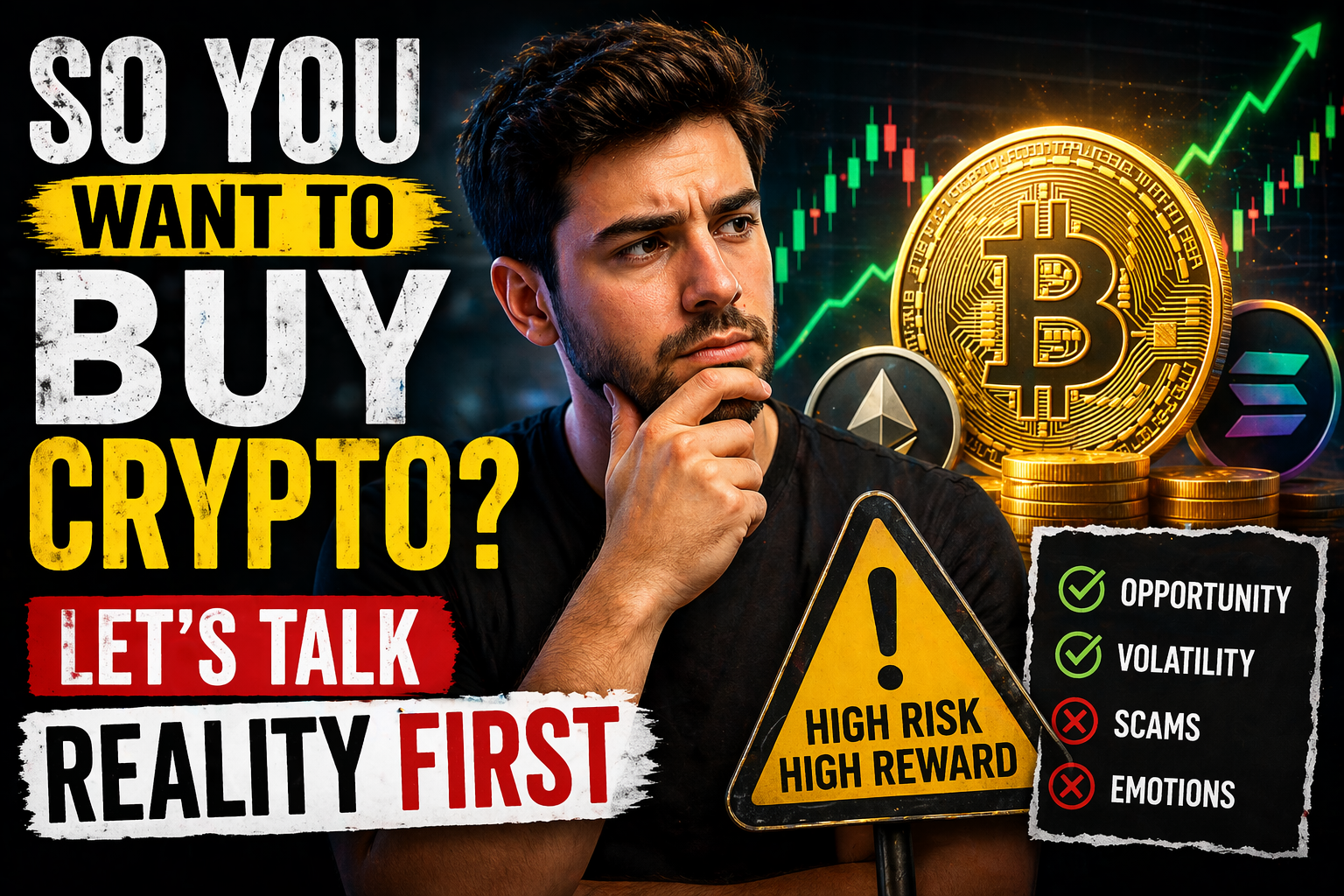
So You Want to Buy Crypto? Let’s Talk Reality First I remember the exact moment I got sucked into this world. It was late 2017, and a buddy of mine who couldn’t balance his own checkbook suddenly started talking about “lambo money.” He was throwing cash at something called Ripple, and I felt this sickening FOMO—fear of missing out—creep up my spine. I almost bought at the absolute top. Almost.
That gut feeling? That’s the first thing you need to understand. Crypto investing isn’t really about Bitcoin or Ethereum or whatever new frog-themed coin is trending on TikTok. It’s about you. It’s about your ability to sit on your hands, ignore the noise, and not do something stupid when your heart is pounding at 2 AM.
Most beginner guides are going to hit you with definitions. Blockchain, hash rates, consensus mechanisms, DeFi, NFTs, layer twos. And sure, you need to know some of that. But not yet. Right now, you need a mindset shift. Because if you walk into this arena thinking it’s a get-rich-quick scheme, the market will eat you alive faster than you can say “cold storage.”
This isn’t a tutorial. This is a conversation. Pull up a chair.
Why Most Beginners Lose Money Before They Make a Cent
Let me paint you a picture. It’s a Tuesday evening. You’re scrolling Twitter or Reddit, and you see a post: “My neighbor just turned $500 into $50,000 on this new coin called ShibaFlokiMoon.” There’s a screenshot of a green candle going straight up. Your brain releases a little dopamine. You think, why not me?
So you rush. You skip the research. You don’t set up a proper wallet. You just Venmo a buddy, have him buy some random token on a sketchy exchange, and you’re in. For three days, you’re a genius. You check the price every five minutes. You’re up 40%. You start calculating how much you’ll have by Christmas.
Then, on day four, it happens. A whale sells. Or the developers pull the liquidity. Or some regulator in a country you’ve never visited makes an announcement. The price crashes 80% in an hour. You panic. You sell everything for a massive loss. And you swear crypto is a scam.
Here’s the hard truth: The crypto market isn’t a scam. But it is a ruthless mirror. It reflects your own greed, impatience, and fear right back at you. If you’re undisciplined in real life—if you buy things you can’t afford, if you chase trends, if you can’t save money—crypto will amplify every single one of those flaws.
So before we talk about what to buy, let’s talk about who you need to become. You need to become boring. Deadly boring. The most exciting thing about your crypto strategy should be how unexciting it is.
The Only Three Rules That Actually Matter
Forget technical analysis. Forget following influencers with laser eyes. If you remember nothing else from these three thousand words, remember these three rules. They have kept me from jumping off a cliff more times than I can count.
Rule Number One: Never invest money you can’t afford to lose to a fire.
I don’t mean “money you’d like to have for a vacation.” I mean money that, if it vanished into thin air tonight, would not change your ability to pay rent, buy groceries, or look your family in the eye. Crypto is volatile. That’s not a bug; it’s the whole point. But volatility cuts both ways. For every person who made a million dollars on Dogecoin, a thousand people lost their down payment on a house. Be the person who keeps their down payment in the bank.
Rule Number Two: Time in the market beats timing the market.
I know. It’s a cliché. But clichés become clichés because they’re true. You are not smarter than the millions of bots and professional traders moving billions of dollars every second. You cannot predict the bottom. You cannot predict the top. The person who buys $100 of Bitcoin every week for two years, regardless of price, will almost always outperform the person who tries to buy the dip with a lump sum and gets it wrong.
Rule Number Three: If you don’t hold the keys, you don’t own the coin.
This is the one that gets people. You sign up for an app like Robinhood or a big exchange like Coinbase. You buy $1,000 of Ethereum. You see the number in your account. You feel good. But here’s the secret they don’t advertise: what you actually own is an IOU. You own a promise that the exchange will give you your coins if you ask for them. But if that exchange gets hacked, or goes bankrupt, or freezes your account for “suspicious activity” (a term they define very loosely), your coins can vanish.
Real ownership means moving your crypto off the exchange and into a wallet where you—and only you—have the secret password, which is called a private key. We’ll get to that. But tattoo this on your brain first.
So What Is This Stuff? (The Bare Minimum You Need to Know)
Okay, fine. You need a little bit of the technical stuff. But I’m going to give it to you straight, without the jargon salad.
Imagine a giant, public notebook. Every page is a “block.” Every time someone sends or receives money, that transaction gets written down on the current page. When the page is full, you stamp it with a special seal (that’s the “hash”), glue it to the previous page, and start a new one. That chain of pages is the blockchain.
This notebook isn’t kept in a bank vault. It’s copied onto thousands of computers all over the world, from a college kid’s laptop in Ohio to a mining rig in Kazakhstan. To change a single transaction, you’d have to hack more than half of those computers at the exact same time. That’s essentially impossible. That’s why people say blockchain is “immutable” or unchangeable.
That’s the magic. Not the coins themselves. The network. The coins are just the reward that keeps people running those computers.
Now, there are thousands of cryptocurrencies. But as a beginner, you need to know about four categories.
First, the King: Bitcoin (BTC). Bitcoin is digital gold. It’s slow. It’s expensive to send. It doesn’t do fancy tricks. But there will only ever be 21 million of them. That’s it. No central bank can print more. For many people, Bitcoin is the whole point. It’s a bet against the traditional financial system. If you do nothing else, just buying a little Bitcoin every month and ignoring it for five years is a perfectly valid—and many would say smart—strategy.
Second, the Workhorse: Ethereum (ETH). If Bitcoin is a calculator (it does one thing, but it does it perfectly), Ethereum is a smartphone. It’s a platform where developers can build things. They build decentralized apps (dApps) for lending, borrowing, trading, art, games, and social media. When you buy Ethereum, you’re not just buying a currency. You’re buying “gas” to power this global computer. This is riskier than Bitcoin, but also has more potential for growth.
Third, the Wild West: Altcoins. This is everything else. Solana, Cardano, Polkadot, Avalanche. Some of these are legit projects trying to solve real problems. Many are pure hype. Some are outright scams. As a beginner, you should treat altcoins like seasoning on a steak. A little bit can add flavor, but if you make a whole meal out of them, you’re going to have a bad time.
Fourth, the Casino: Meme Coins. Dogecoin. Shiba Inu. And the thousand other coins named after dogs, cats, and cartoon characters. Let me be blunt: buying a meme coin is not investing. It’s gambling. You are betting that you can find a bigger fool to sell it to before the music stops. Some people get rich. Most people get wrecked. If you want to play in the casino, take a tiny amount of money—money you would spend on a lottery ticket or a night at the movies—and consider it gone the second you buy. Seriously. Gone.
Your First Purchase: A Step-by-Step Walkthrough
Let’s say you’ve decided to take the plunge. You’ve got $500 that won’t break you if it disappears. You’re ready to become boring. Here’s exactly how to do it, step by step, without getting scammed.
Step One: Pick Your Exchange. This is where you’ll turn your regular dollars into crypto. For a beginner in the US, you have three solid choices: Coinbase, Kraken, or Binance US. They’re all relatively safe, regulated, and user-friendly. Coinbase is probably the easiest for a total newbie, but its fees are higher. Kraken is a little more complex but has lower fees and better customer support. Pick one. Don’t overthink it.
Step Two: Verify Your Identity. This is called KYC—Know Your Customer. You’ll have to upload a picture of your driver’s license and maybe a selfie. Yes, it feels invasive. Yes, it’s annoying. But it also keeps the exchange from getting shut down for money laundering. Just do it.
Step Three: Deposit Funds. Connect your bank account or debit card. I recommend using a bank transfer (ACH) instead of a debit card. Card fees are higher, and your bank might flag it as suspicious. An ACH transfer takes a few days, but it’s free or very cheap.
Step Four: Place Your Order. Now the fun part. You want to buy, say, $100 of Bitcoin. Don’t buy at “market price” with a market order? Actually, as a beginner, yes, use a market order. It’s simpler. You say “I want to buy $100 worth of Bitcoin at whatever the current price is,” and the exchange does it. Later, you can learn about limit orders (where you set the price you want to pay), but for small amounts, market orders are fine.
Step Five: Wait. Your order fills in seconds. Congratulations. You are now a crypto investor. But remember Rule Three? You don’t really own it yet. It’s sitting on the exchange. For small amounts—under $500—leaving it on a major exchange like Coinbase is probably fine. But for anything you’d be truly sad to lose, you need a wallet.
The Wallet Question: Where Real Safety Begins
A crypto wallet doesn’t actually hold your coins. Coins live on the blockchain. A wallet holds your keys—the secret codes that give you permission to move those coins.
There are two main types: hot wallets and cold wallets.
Hot wallets are connected to the internet. Think of them like the wallet in your back pocket. Convenient. Easy to use. But if a pickpocket (hacker) gets close, they can take it. Popular hot wallets include Metamask (for Ethereum stuff) and Phantom (for Solana stuff). There’s also a great one called Trust Wallet that handles many different coins. Hot wallets are fine for small amounts you plan to trade or use.
Cold wallets are not connected to the internet. Think of them like a safe bolted to the floor in your basement. They are physical devices that look like USB sticks. Ledger and Trezor are the big names. You plug it into your computer only when you want to make a transaction, then unplug it. A hacker on the other side of the world cannot steal what isn’t online. For any amount over $1,000, or any amount that would hurt to lose, buy a hardware wallet. It costs $60-$150. That’s the price of peace of mind.
Here’s the scary part: when you set up a wallet, it will give you a “seed phrase.” This is usually 12 or 24 random words. Example: “abandon art banana cat desert eagle frog grass hotel icon jungle kite.”
Write these words down on a piece of paper with a pen. Do not take a photo. Do not type them into your computer. Do not save them in a note on your phone. If anyone gets those words, they have your money. If you lose those words, you lose your money forever. There is no “forgot password” button in crypto. There is no customer support that can help you. Store that paper in a fireproof safe or a safety deposit box. I’m not joking.
The Emotional Rollercoaster (And How to Survive It)
You’ve bought in. Now the real test begins.
In your first month, you will experience emotions you didn’t know you had. You will check the price thirty times a day. You will obsess over news headlines. You will wake up at 3 AM and instinctively grab your phone.
The market will go up 15% in a day. You will feel like a genius. You will start looking at apartment listings in Monaco. You will think, “I should put in more. I should sell the car.”
Then, a week later, the market will drop 20%. You will feel sick. You will read comments from people saying “It’s going to zero.” You will want to sell everything just to make the anxiety stop.
This is the game. This is why 95% of people fail.
The only winning move is to detach. Create a schedule. Maybe you buy on the 1st and the 15th of every month. Maybe you check your portfolio only on Sundays. The rest of the time, you live your life. You go to work. You walk your dog. You watch a movie.
If you can’t do that—if the price movement consumes your thoughts—then crypto might not be for you. And that’s okay. Seriously. There’s no shame in saying “this isn’t good for my mental health.” Your sanity is worth more than any potential gain.
The Scams to Watch Out For (Because They’re Everywhere)
The crypto space is like the early internet in the 90s. Amazing potential. Also, total lawlessness. Scammers are sophisticated. They are patient. They are friendly. Here’s what to avoid.
The “Too Good to Be True” Yield. Someone promises you 2% interest per day on your crypto. That would turn $1,000 into over $1 million in a year. It’s mathematically impossible. It’s a ponzi scheme. Run.
The Giveaway Scam. A verified-looking Twitter account for Elon Musk or some famous crypto person says “Send 1 Bitcoin to this address, and I’ll send 2 back!” No one is giving away free money. Ever. Not even on Christmas.
The Random DM. A beautiful woman or a helpful “support agent” messages you on Telegram or Discord. They want to “help you stake your coins” or “verify your wallet.” They will send you a link. The link will drain your wallet. Never, ever click links from strangers in crypto.
The Rug Pull. This is when a new coin gets hyped up, people buy it, and then the creators sell all their holdings at once, crashing the price to zero. This happens every single day with meme coins. The only way to avoid it is to not buy random new coins.
A simple rule: If you can’t explain what a project does in one sentence, and you can’t find its website, whitepaper, and the names of its developers with a simple Google search, you are not investing. You are donating your money to strangers.
Building Your Simple, Boring, Profitable Strategy
You’ve waded through the warnings. Now, let’s build a plan.
Here’s what a sensible, boring, adult crypto portfolio looks like for a beginner:
- 60-70% Bitcoin. This is your foundation. It has the longest track record, the most liquidity, and the simplest story. When in doubt, buy Bitcoin.
- 20-30% Ethereum. This is your growth engine. You’re betting that the world of decentralized finance and apps actually takes off.
- 10% “Fun Money.” This is for altcoins or even meme coins. But you treat this as already lost. If it goes to zero, shrug. If it 10x’s, great, but you don’t count on it.
That’s it. That’s the whole strategy. No day trading. No leverage (borrowed money—never, ever use leverage as a beginner). No chasing the hottest new thing.
You buy those percentages on a schedule—weekly, bi-weekly, or monthly. You ignore the price. When you have a meaningful amount (say, $1,000 or more), you move it off the exchange to your hardware wallet. You write down your seed phrase. You put it in a safe place.
And then you go live your life.
A Word on Taxes (The Unsexy But Necessary Bit)
The government wants its cut. In most countries, including the US, every time you sell crypto for dollars, or trade one crypto for another, it’s a “taxable event.” You owe capital gains tax on the profit.
If you buy Bitcoin for $1,000 and sell it for $5,000, you owe tax on that $4,000 profit. If you hold it for more than a year, you pay a lower “long-term” rate. If you hold it for less than a year, you pay your regular income tax rate, which is higher.
Keep records. There are software tools like CoinTracker or Koinly that connect to your exchange and do the math for you. Pay your taxes. The IRS has gotten very good at finding crypto transactions. Don’t be the guy who gets audited because he forgot to report a $200 trade.
The Final, Honest Truth
I’m going to level with you. Crypto could go to zero. Not Bitcoin, probably. But the whole industry? A global regulatory crackdown, a fatal technical flaw, or a world-changing invention could render it all obsolete. It’s not impossible.
But crypto could also change the world. It could give people in unstable countries a way to save their wealth. It could automate trust. It could build a financial system that doesn’t require asking permission from a bank manager on a Tuesday afternoon.
The truth is, nobody knows.
What I do know is this: the best investment you can make right now is not in crypto. It’s in your own education. Read The Bitcoin Standard by Saifedean Ammous. Read The Internet of Money by Andreas Antonopoulos. Listen to podcasts like What Bitcoin Did or Bankless. Don’t listen to YouTubers with thumbnails of them pointing at rocket ships.
Start small. Stay humble. Stay boring.
And when the market crashes—and it will crash, probably more than once—and all your friends are panicking and selling in fear, you’ll be the one with the steady hand. You’ll check your schedule. You’ll buy your regular amount. You’ll move it to your cold wallet. You’ll close the laptop. And you’ll go to sleep, because you know something they don’t.
You know that you’re not a trader. You’re not a gambler. You’re an investor. And investors think in years and decades, not minutes and hours.